
A co-operative housing society is a registered group of flat owners. It is formed under the Maharashtra Co-operative Societies Act, 1960. The society looks after the building and the shared areas. Every member gets one vote, and a managing committee does the daily work.
When you buy a flat, you think about price, location and facilities. But the society matters just as much. It affects your monthly cost, your parking, your papers and how decisions are made after you move in. This guide explains how a co-operative housing society in Pune works and what to check before you pay the booking amount.
Key Takeaways
- A society is a legal group of flat owners, and each member has one vote.
- The builder should help form the society and then hand over the land and building to it with a conveyance deed.
- A society and an apartment owners association are different. Check which one is written in your agreement.
- Maharashtra added a new chapter for housing societies in June 2026, so old online guides may be out of date.
What Is a Co-operative Housing Society?
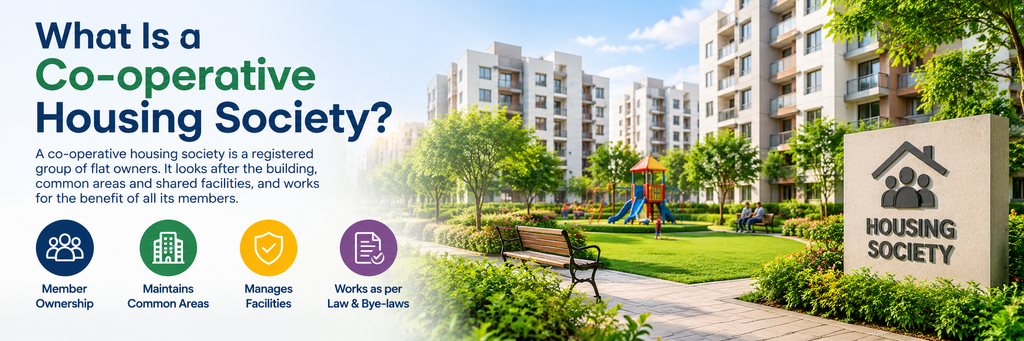
Think of it as a small elected team for your building. The flat owners share the work of keeping the property in good condition. The society looks after the lifts, stairs, security, common lights, water supply, cleaning, garden and repairs of shared areas. It also keeps the accounts and the list of members.
The managing committee does the daily work as per the law and the society’s rules, called bye-laws. Members take part in bigger decisions in the general body meeting. After registration, the society becomes a legal body on its own. It can open a bank account, hire staff and sign contracts for all members.
Co-operative Housing Society vs Apartment Owners Association
Check this first in your agreement. Both are common in Pune, but they work in different ways.
| Point | Co-operative Housing Society | Apartment Owners Association |
| Law | Maharashtra Co-operative Societies Act, 1960 | Maharashtra Apartment Ownership Act, 1970 |
| Ownership | The society owns the land and building. Members hold share certificates. | Each owner owns the flat and a share of the land and shared areas. |
| Who checks the work | Registrar of Co-operative Societies | Mostly the association’s own deed and bye-laws |
| Voting | One member, one vote | As per the association’s rules |
| Disputes | Co-operative authorities and Co-operative Court | Civil court |
Neither one is wrong for every buyer. But whichever one the builder offers, ask for it in writing before you book.
How a Housing Society Is Formed
In a new project, the builder usually starts the work after enough buyers have taken their flats. First, the buyers hold a meeting and choose a chief promoter. The builder often does this job. All promoters get a written notice of the meeting. Then they apply to the Registrar of Co-operative Societies with the needed papers. The Registrar checks them and gives a registration certificate. After that, the society holds its first general meeting and chooses a managing committee. In the end, the builder signs the conveyance deed in favour of the society.
The law gives time limits for forming the society and for the conveyance. These are different under the Maharashtra Ownership Flats Act (MOFA) and RERA. Which one applies depends on the project. Ask the builder and your lawyer which law covers your flat. If the society is not formed yet, ask who will do the registration and how long it will take.
Check If the Society Is Registered

Registration gives the society a proper structure to do its work and keep records. But registration alone does not prove that the land title is clear or that all approvals are in place.
So ask for the papers listed in the table below. Also check that the project is registered with MahaRERA. Our guide on how to verify a Pune property under RERA shows how to do it. Also find out if the project comes under Pune Municipal Corporation or Pimpri Chinchwad Municipal Corporation, so you can check the approvals from the right office.
| Document | Why it matters |
| Agreement for sale or sale deed | Records the deal and your ownership rights |
| Property title documents | Show who has legal rights over the property |
| Occupancy Certificate, where needed | Shows the building is approved for use |
| Approved building plan | Lets you match what was built with what was approved |
| Society registration certificate | Confirms the society legally exists |
| Registered bye-laws and share certificate | Show the rules and your membership |
| Conveyance papers | Show if the land title has moved to the society |
| Maintenance statements | Show unpaid dues |
| No-objection letter from the society (resale) | Shows the society knows about the sale and has no dues against the flat |
This list is only a general guide. A property lawyer can tell you what your deal needs.
Understand Monthly Maintenance
Maintenance pays for the services that keep the building running. This includes security, cleaning, lift care, common electricity, water costs and repair of shared areas. The amount is different in every society. It depends on the size of the project, the services and the approved expenses. Before you buy, ask for the latest bill and a written list of what it includes.
Maintenance is charged for the flat, whether or not someone lives in it. After a society is registered, maintenance is generally charged as per its bye-laws, even if the builder is still managing the building. Check this against your agreement, and ask your lawyer if a bill looks unclear.
Societies also keep a sinking fund. This is money kept aside for big repairs like waterproofing or painting, so owners do not get a large bill at once. For a resale flat, ask the seller if any maintenance is unpaid. Also ask the society if it has special charges or big repairs planned, such as a new lift or plumbing work. Your sale agreement should clearly say who pays the old dues, the buyer or the seller.
Non-Occupancy Charges for Rented Flats
If you plan to rent out the flat, ask about non-occupancy charges. These are extra charges a society may collect when the owner does not live in the flat. In Maharashtra, they are capped at 10% of the service charges. How this applies to your flat depends on your society’s bye-laws, so read them before you sign.
What Is a Conveyance Deed?
When you buy a flat, you get the right to live in it. The land under the building and the shared areas stay with the builder until a conveyance deed is signed. This deed moves the ownership of the land and building to the society.
Without it, the society does not fully own the property. This can cause trouble when the building is rebuilt, when a bank checks the papers or when an owner wants to sell. If the conveyance is pending, ask the builder or the society why, and what has been done so far. If a builder does not act, Maharashtra has a process called deemed conveyance for societies that qualify. It takes time, so a builder who completes the conveyance on schedule saves owners a lot of effort.
Settle Parking Before You Book

Parking causes many arguments in Pune societies. Before you sign, find out if parking is included in the price, if the space is open or covered, and what the approved plan says about it. Also ask if the space is given to you or comes with conditions, and how visitor parking works. Get all of this in writing. A spoken promise is not enough.
Membership and Transfer After You Buy
After you buy, you need to complete the membership and transfer steps with the society. This usually needs the registered purchase document, a membership form and a few other papers asked for by the rules and bye-laws.
For a resale flat, ask the seller for the share certificate and the membership records. Confirm which papers the society needs, if any dues are left and which charges are allowed by law. Do not trust fixed transfer fee amounts from old articles. Check the current rules and the society’s bye-laws instead.
Role of the Managing Committee
The committee makes the budget, keeps the accounts, arranges repairs, handles security and cleaning, collects the approved charges and calls meetings. Ask how the society shares news with members and how it handles complaints. Regular meetings and clear accounts are a good sign.
Your Rights and Duties as a Member
As a member, you can vote in general meetings, stand for the committee, see the accounts and records, and use the shared areas. If a problem is not solved inside the society, you can go to the co-operative authorities.
In return, you must pay your maintenance on time, follow the bye-laws, take the society’s permission before big changes in your flat and take care of shared spaces. A society’s decisions must follow the law. If you think a charge or a decision is wrong, ask for the written rule behind it and speak to a qualified professional.
Redevelopment in Older Societies
Redevelopment means rebuilding an old building. If you are buying a resale flat in an older building, ask if the society has talked about redevelopment or signed any agreement with a developer. It needs the members’ consent and follows its own steps under the rules. It can change your costs and your living plans for years, so ask for the meeting minutes and read them with your lawyer.
What Changed in Maharashtra’s 2026 Housing Society Rules?
On 18 June 2026, Maharashtra notified the Maharashtra Co-operative Societies (Amendment) Rules, 2026. It added a new Chapter XI-B, with Rules 106C-1 to 106C-14, to the Maharashtra Co-operative Societies Rules, 1961. This gives housing societies their own set of rules.
The chapter covers name reservation, registration, membership (including associate and provisional members), nominations, society funds and charges, management, meetings and recovery of unpaid dues. For a buyer, the point is simple. Old blogs and videos may talk about the earlier rules, so check what is in force today. Not every rule affects every purchase in the same way, so read the official text and your society’s bye-laws. You can find official documents in the Acts and Rules section of the Maharashtra Co-operation Department.
Why the Builder You Choose Matters
A society works best when the handover is clean. That means the papers are ready, the facilities are complete, the accounts are clear and the builder is still easy to reach in the first months. Our guide on how to choose a real estate developer in Pune covers what else to look at.
AUTI Group was started in 1996 by Mr. Babasaheb Laxman Auti and is based in Ravet, Pune. The group has completed 80+ projects across Pune, Satara, Solapur, Kolhapur and Raigad, and co-operative housing is a big part of that work. For example, Renuka Nagari in Majrewadi, Solapur, has 11 co-operative housing societies. You can see every project on the completed projects page.
If you want to buy now, the upcoming projects page lists four co-operative projects in Sangavade, Maval: Onkar Greens, Shubhshree Associates, Petal Greens and Terra Greens. Shubhshree Associates is listed with 39 row houses and 200 flats. To compare home sizes in this area, read our guides on 2 BHK flats in Sangavade and 3 BHK flats in Sangavade. If row houses interest you, see our guide on row houses in Maval.
| About AUTI Group | |
| Started in | 1996 |
| Families served | 13,500+ |
| Completed projects | 80+ |
| Projects under construction | 4 |
| Projects underway | 12 |
| Joint ventures completed | 46 |
Frequently Asked Questions
What is a co-operative housing society in Pune?
It is a registered group of flat owners who manage their building or project together. It works under the Maharashtra Co-operative Societies Act, 1960, its rules and its registered bye-laws. Each member has one vote.
What is the difference between a society and an apartment owners association?
In a society, the society owns the land and building, and members hold share certificates. In an association, each owner owns the flat and a share of the land and shared areas. They also work under different laws.
Is society registration important when buying a flat?
Yes, it gives the society a proper structure. But you should also check the title, approvals and other papers separately.
How much is maintenance in a Pune housing society?
There is no single amount for every society. It depends on the building, the services and the approved expenses. Ask for a written list of charges before you buy.
Do I have to pay maintenance if I am not living in the flat?
Yes. Maintenance is charged for the flat, whether or not someone lives in it.
What are non-occupancy charges?
They are extra charges a society may collect when the owner does not live in the flat, for example when it is rented out. In Maharashtra, they are capped at 10% of the service charges. Check your society’s bye-laws to see how it applies to your flat.
Can a housing society charge a transfer fee?
Some charges may apply for membership or transfer. The amount and the steps must follow the law and the bye-laws, so check the current rules and do not depend on old amounts.
What is a conveyance deed?
It is the document that moves the land and building from the builder to the society. It matters for the society’s ownership and for any future redevelopment.
What if the builder delays the conveyance?
The society can take legal steps, including the deemed conveyance process if it qualifies. This takes time, so ask about the conveyance plan before you buy.
What should I check before buying a resale flat?
Check the sale papers, title, approvals, society registration, membership records, dues, parking papers and conveyance status. Also ask for a no-objection letter from the society. A property lawyer can tell you if you need more.
What changed under the 2026 amendment rules?
Maharashtra added Chapter XI-B, with Rules 106C-1 to 106C-14, as a separate set of rules for housing societies. Read the official notification and your society’s bye-laws for exact requirements.
Should You Buy a Flat in a Co-operative Housing Society?
For most buyers in Pune, a well-run society is a good fit. It gives you a clear way to share costs, keep the building in good condition and have a say in decisions. What matters most is how the project is set up from the start: clear papers, a builder who completes the formal work and owners who take part.
Before you decide, check the title, the society’s registration, the conveyance status, the dues and the transfer steps. Visit the site and talk to families who live in the builder’s earlier projects. You can read more buying guides on the AUTI Group blog.
If you want to know about current homes and book a site visit, contact the AUTI Group team.