
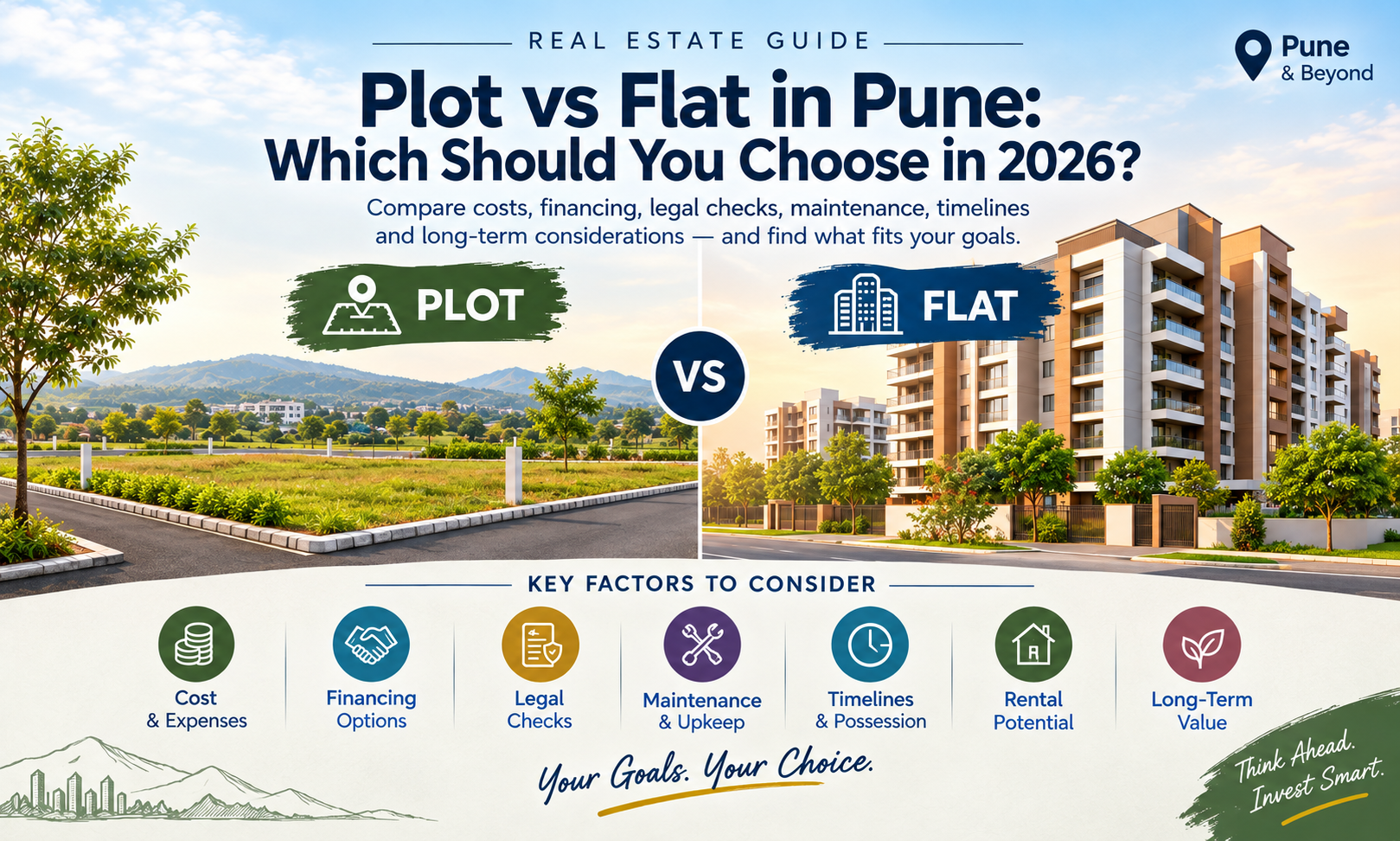
“Plot or flat?” is one of those questions many property buyers in Pune eventually ask themselves, and it rarely has a one-size-fits-all answer. A flat can get you into a home faster with less day-to-day involvement, while a plot gives you greater control over what you build and when you build it. Neither option is universally better. The right choice depends on your budget, timeline, preferred lifestyle, and whether your primary goal is to live in the property, build a home later, or hold it as a long-term asset.
This guide compares plot vs flat across the factors that matter when buying property: cost, financing, legal checks, maintenance, timelines, rental potential, and long-term considerations. It also looks at how the choice can play out across Pune’s western growth corridor, including Maval, where both residential flats and plotted developments are available.
What You’re Actually Buying: Plot vs Flat, Defined
- A flat is a residential unit within a multi-storey or multi-unit building. You own the individual unit along with the applicable share or rights in common areas and facilities. The housing society, association, or developer generally manages common facilities such as lifts, security, gardens, and amenities, depending on the project and its stage. Where applicable, residential projects must comply with RERA requirements and applicable state regulations.
- A plot is a defined parcel of land that you can purchase to build on later, subject to applicable planning rules, approvals, development permissions, and land-use regulations. In a plotted development, basic infrastructure such as internal roads and demarcated plots may be provided, while the construction of an individual home is generally the buyer’s responsibility.
Plot vs Flat at a Glance
| Factor | Flat | Plot |
| Upfront cost | Includes the cost of the residential unit and applicable project charges | Land cost is the primary purchase cost; construction is separate |
| Financing | Residential home loans are widely available for eligible properties | Plot financing can have different eligibility and loan-to-value conditions |
| Key legal checks | RERA registration where applicable, title, sanctioned plans, carpet area, and project approvals | Title, encumbrances, land-use status, approved layout, development permissions, and plot boundaries |
| Ongoing cost | Society or maintenance charges, utilities, property tax, and other applicable costs | Property tax and basic upkeep; construction-related costs come later |
| Move-in timeline | Ready possession or a disclosed possession timeline | Construction is required before the property can be occupied |
| Rental potential | Can generally be rented after possession and subject to applicable rules | Normally does not generate residential rental income until a property is constructed |
| Control over design | Layout and building design are generally predetermined | Greater flexibility to design and build, subject to approvals |
| Best suited for | Buyers seeking a managed residential home | Buyers with a longer timeline who want greater control over future construction |
The sections below explore these differences in more detail.
Upfront Cost and Financing
Flats generally have a higher purchase price than an undeveloped plot in the same broad area because the price includes the constructed residential unit and the project’s infrastructure, amenities, and other associated costs. However, the total cost depends heavily on the project’s location, size, specifications, amenities, taxes, registration, and other charges. Flats can also be relatively straightforward to finance because eligible properties have widely available residential home-loan products. The exact loan amount, interest rate, tenure, and loan-to-value ratio depend on the lender, property, borrower profile, and applicable regulations.
Plots can have a lower initial purchase price because you are buying the land rather than a completed home. However, plot financing can have different eligibility requirements and loan-to-value conditions from a standard residential home loan. Some lenders may also have specific requirements relating to the plot’s approval status and the borrower’s construction plans. If you plan to build later, remember that construction is a separate financial commitment. Your overall budget may include the plot price, registration and transaction costs, design and approval expenses, construction, utilities, interiors, and financing costs.
Legal and Documentation Checks
Legal due diligence is important for both flats and plots, but the documents and approvals you need to examine can differ.
| Checking a flat | Checking a plot |
| Verify project registration on the MahaRERA portal where RERA applies | Check the project’s RERA registration where applicable |
| Check the promoter’s details and project disclosures | Verify the seller/developer’s title and ownership rights |
| Review the sanctioned plans and applicable approvals | Verify the approved layout and plot demarcation |
| Confirm the carpet area and agreement details | Check land-use status and applicable development permissions |
| Check possession-related information and applicable certificates | Check for encumbrances, access rights, and potential boundary or encroachment issues |
Understanding NA Status in Maharashtra
Land-use rules in Maharashtra have changed following the Maharashtra Land Revenue Code (Second Amendment) Act, 2025. In cases where the proposed residential use is permissible under the applicable Development Plan, Regional Plan, or relevant planning regulations, and the competent Planning Authority grants the required development permission or approves the building plan, a separate Collector’s NA permission may not be required. This does not mean that buyers should ignore land-use or approval checks. The exact requirements depend on the location, planning authority, applicable plan, project, and proposed use of the land.
Before purchasing a plot, verify the title, land-use status, approved layout, development permissions, access, encumbrances, and other applicable records for the specific property. An independent property lawyer can help review the documents before you commit. For flats, checking RERA registration where applicable, sanctioned plans, title-related disclosures, agreement details, carpet area, possession information, and applicable approvals is equally important.
Maintenance and Ongoing Costs
Flats generally come with recurring maintenance expenses. These may cover security, common-area cleaning, lifts, landscaping, repairs, amenities, and other shared facilities. Depending on the project, these charges may be collected monthly, quarterly, or according to the society or association’s applicable rules.
Plots generally have fewer day-to-day maintenance requirements before construction. However, owners may still need to pay property tax and take care of basic upkeep. If you purchase a plot but do not live nearby, you may also need local oversight to keep the property secure and address issues such as overgrowth, boundary maintenance, or unauthorised access.
Once construction begins, a plot can involve additional recurring costs associated with the house itself.
Timeline: Ready to Live In vs Ready to Build
A ready-possession flat can allow you to move into a home relatively quickly, subject to completion and possession formalities. For an under-construction flat, the project has a disclosed possession timeline, subject to the terms of the agreement and applicable regulations. A plot gives you ownership of the land, but it does not give you a ready home. If your goal is to live there, you will need to plan the design, approvals, contractor, financing, construction, utilities, and interiors.
Construction can take a year or more depending on the size and design of the home, approvals, contractor availability, materials, site conditions, and other factors. If you need a home within a short timeframe, this additional process is an important part of the decision. If your goal is long-term land ownership and you do not need immediate occupancy, the additional construction timeline may be less important.
Appreciation and Rental Potential
Flats can provide practical near-term utility because they can be occupied or rented after possession, subject to the project’s rules and applicable regulations. A completed residential property may therefore provide both housing utility and potential rental income. Plots can also offer long-term appreciation potential, particularly where surrounding infrastructure, connectivity, employment activity, and residential development increase over time. However, appreciation is highly location-specific. Factors such as road access, planning permissions, infrastructure development, demand, title clarity, surrounding development, and overall market conditions can significantly affect the property’s future value.
A plot does not normally generate residential rental income while it remains vacant. If you construct a home or another permitted property on the land, it may potentially generate rental income, subject to applicable permissions and market demand. For this reason, buyers should not assume that either plots or flats will automatically deliver higher returns. The purchase price, location, holding period, financing cost, rental potential, and future development prospects all matter.
Lifestyle and Control: What Each Format Actually Feels Like
Flats, particularly in managed or gated residential communities, can offer shared security, common amenities, and a more structured living environment. This can be convenient for families, first-time buyers, and people who prefer a home that does not require them to manage construction themselves.
Plots offer greater flexibility in future construction. Depending on the applicable development rules and project conditions, owners can plan a home around their preferred layout, room configuration, parking requirements, outdoor space, and lifestyle needs. That flexibility also comes with more responsibility. The buyer needs to manage design, approvals, construction, contractors, budgets, and timelines.
Plot vs Flat in Pune’s Western Growth Belt
Pune’s western corridor includes established and developing locations such as Ravet, Sangavade, and parts of the wider Maval belt. These areas allow buyers to consider both residential flats and plotted developments, depending on their requirements and budget.
In Maval, proximity to the Mumbai-Pune Expressway and ongoing development across the wider region make location, connectivity, infrastructure, and future development important considerations when evaluating property. For someone comparing the two formats, looking at actual projects in the same broad corridor can be more useful than comparing plots and flats only in theory.
AUTI Group has residential projects across this broader corridor. Its gated flat communities, including Terra Greens, Onkar Greens, Orchid Greens, and Petal Greens, are located in Sangavade, while Wonderland in Adhale is a plotted development with around 1,200 plots. This allows buyers to compare two different property formats within the broader Ravet-Sangavade-Maval region based on their own timeline, budget, and intended use.
About AUTI Group
AUTI Group was founded in 1996 and has developed residential and investment projects across Ravet, Sangavade, Gahunje, and the wider Maval region.
| Key Achievement | Details |
| Happy Families | 13,500+ |
| Completed Projects | 80+ |
| Projects Under Construction | 4 |
| Projects Underway | 12 |
| Joint Ventures Completed | 46 |
Real Estate & Industry Recognition
- Lokmat Gaurav Kartutvacha Award
- Recognition by Dream Home Associates in the real estate industry in November 2022
- Udyojak Sneh Melava & Puraskar Vitaran Sohala 2023 by Marathwada Commerce & Industries Association
Leadership & Community Recognition
The company’s leadership has also received recognition through initiatives and events including:
- ISO 9001:2015 Certification during the Director’s tenure as Chairman of Maval Taluka Prathamik Shikshakanchi Sahakari Pat Sanstha
- Sevapurti Gaurav Sohala
- Recognition by Shikshak Vichar Manch
- Token of Appreciation from JSPM’s Rajarshi Shahu College of Engineering
- Maharashtra Rajya Marathi Patrakar Sangh Sanman Sohala 2023
A Simple Decision Framework
A flat may suit you if:
- You want to move into a home relatively soon.
- You prefer a managed residential community.
- You want shared security and amenities.
- You prefer not to manage construction yourself.
- You may want to rent the property after possession.
A plot may suit you if:
- You have a longer time horizon.
- You want greater control over future construction.
- You are comfortable planning and managing a construction project.
- You do not need immediate occupancy.
- You want to own land and decide later how to develop it, subject to applicable rules and approvals.
Either way:
Verify the property’s title, approvals, land-use status, project registration where applicable, development permissions, transaction documents, and other relevant records before making a purchase decision. Avoid relying only on general claims about appreciation or financing.
Frequently Asked Questions
Is a plot a better investment than a flat?
It depends on your budget, timeline, intended use, financing, rental requirements, and the specific property. A flat can provide immediate residential utility and potential rental income after possession, while a plot provides land ownership and flexibility for future construction. Actual investment performance depends heavily on the property’s location, purchase price, holding period, financing cost, demand, and future development.
What is an NA plot?
NA stands for non-agricultural. In Maharashtra, land-use and development permissions depend on the applicable planning framework and the specific property. Following recent changes to the Maharashtra Land Revenue Code, a separate Collector’s NA permission may not be required in certain cases where the proposed use is permissible under the applicable plan, and the competent Planning Authority grants the required development permission or approves the building plan. Buyers should verify the current land-use status and approvals for the specific plot.
Can I get a home loan for a plot the same way I can for a flat?
Not necessarily. Plot loans can have different eligibility criteria, loan-to-value conditions, interest rates, and documentation requirements from residential home loans. Some lenders may also have conditions relating to construction. Check the lender’s current terms for the specific plot before finalising your budget.
Is it cheaper to buy a plot and build later, or buy a ready flat?
The plot itself may have a lower purchase price than a comparable completed flat, but construction is a separate expense. Once you include construction, design, approvals, financing, utilities, interiors, and other costs, the total cost of a self-built home can vary significantly. Compare the complete project cost rather than only the initial plot price.
Are flats or plots easier to maintain if I don’t live locally?
A flat can be easier to manage remotely because common-area maintenance, security, and shared facilities are generally handled by the society, association, or project management structure. A vacant plot may require local oversight for basic upkeep, boundary maintenance, and security.
Does AUTI Group offer both plots and flats in the same area?
AUTI Group offers both formats within the broader Ravet-Sangavade-Maval corridor. Its flat communities, including Terra Greens, Onkar Greens, Orchid Greens, and Petal Greens, are in Sangavade, while Wonderland is a plotted development in Adhale.
Should You Buy a Plot or a Flat?
There is no universal answer to the plot-vs-flat question. Your decision should depend on how soon you need a home, how much you want to invest initially, how you plan to finance the purchase, whether you want rental income, and how much responsibility you are willing to take on for future construction.
A flat can provide a more straightforward path to managed residential living, while a plot can provide greater flexibility for future development. The right option depends on the specific property and your individual requirements. If you want to compare both formats directly, AUTI Group offers gated flat communities in Sangavade and a plotted development, Wonderland, in Adhale, within the broader Maval region.
Explore AUTI Group’s residential projects and connect with the team to learn more about the available options.